Showing posts with label Sam. Show all posts
Tuesday, July 17, 2012
Friday, July 6, 2012
Om nom
For immigrants, it is said, food is the last to go, custom-wise. Why styles of dress or accents fade more quickly, I offer only this supposition: tasting one's food can reveal much about a person. In a single bite, you may be transported to one's childhood, or fully understand the depth and breadth of one's creativity. Indeed, the very essence of one's past, present, and future can be ascertained in a simple stew. Perhaps that's too much, you say. Obviously, you're not a foodie.
Food was--and in someways still is--the great medium for my family. It is used to comfort, celebrate, and console. A single red plate was displayed by your seat on your birthday, it's inscription reading "You are special today." Eating off that plate was almost as good as not having to clean it: it was your birthday for crying out loud, you couldn't be bothered with washing dishes.
It was more than just calories and carbohydrates, though: I use the word medium purposefully. It was around that dinner table that the majority of our interaction took place. Sure, the occassional Braves' game took the show, but our meals were usually taken together and at that table. The meal gave way to clean-up, but eventually, the focus shifted back to the table. Sometimes dessert, most times coffee, this time was ours, and we eeked out every last second.
What began as a stiff, rectangular table with a clearly defined head, eventually turned into a relaxed, circular table as we got older, no doubt signifying our transition into the adult world. Our conversation more balanced, our interaction more democratic. No one seat was greater than the other. Unless you were closer to the chicken. This conveyed innumerable powers, selecting and distributing as you pleased. One for you, two for me...
Imagine my relief when I arrived in this country, greeted by multiple followers of this great tradition we call force-feeding. If full, don't clean your plate, my travel guide says, lest a heaping spoonful of food be put on your plate. Hospitality reigns in Kenya, and the preparing and serving of food is the premier way of displaying this act. In a land where portion sizes clearly outweighs the means to provide such a serving, it is especially poignant to be treated to a traditional Kenyan meal. By my count, I'm at 8. Dear God, please let there be more.
The fare here is hearty, and rarely in need of any extra seasoning: the quality of the produce alone imparts more flavor than imaginable. Fresh mango, papaya, bananas, passion fruit, pineapple, and oranges, each sampling better than the last, or so it seems. These would accompany a typical breakfast platter of mandazi (Kenyan beignets), spanish omelettes, or toast and jam. Other meals are a variation on some basic themes, but aren't slouches in their own right. Curries, stews, and stir-fry predominate, highlighting the tasty vegetables produced here: potatoes that rival yukon golds, the best cabbage I've eaten, and some tomatoes that remind me of home. These dishes are served with either rice, ugali (similar to corn grits), or chapati (unleavened flat bread). A cook here is first measured by his chapati. Add a little baking powder to the batter, and tah-dah, you have the makings for mandazi. So simple, so delicious.
Order a cup of tea in the states, and you're waiter might ask if you want lemon or milk with your tea. In Kenya, the answer to "Will you take tea?" should most certainly be a yes. Don't expect a dark brown liquid to be served in your cup, though. Tea with steaming-hot milk--lots of it--is the preferred route. If you're lucky, some ginger or rosemary will be thrown into the water before you are served. I haven't had a real cup of coffee in perhaps 4 weeks, but honestly, I haven't missed it.
We've enjoyed having a house to ourselves for the last week, and we have especially enjoyed having a kitchen in which to prepare meals. I've found a stalwart in Malia to cook with. Her knowledge of cooking techniques and recipes is impressive, and her generous use of butter won her instant legitimacy in my eyes. Our meals cost roughly 1200-1500 Kenyan shillings, which translates to 15-18 dollars. Not bad for feeding 7 people. And by feeding, I mean feeding. We've indulged in coconut curries, chocolate chip oatmeal cookies, and even deep dish pizza. For the Fourth, we celebrated with chicken pot pie (and, ahem, a homemade pie crust), cole slaw, baked beans, and a zesty potato salad. Our only fireworks were the ones created by the pan full of banana's foster, but trust me, they were sufficient.
To think we thought we were going to lose weight on this trip...sike.
SS
Food was--and in someways still is--the great medium for my family. It is used to comfort, celebrate, and console. A single red plate was displayed by your seat on your birthday, it's inscription reading "You are special today." Eating off that plate was almost as good as not having to clean it: it was your birthday for crying out loud, you couldn't be bothered with washing dishes.
It was more than just calories and carbohydrates, though: I use the word medium purposefully. It was around that dinner table that the majority of our interaction took place. Sure, the occassional Braves' game took the show, but our meals were usually taken together and at that table. The meal gave way to clean-up, but eventually, the focus shifted back to the table. Sometimes dessert, most times coffee, this time was ours, and we eeked out every last second.
What began as a stiff, rectangular table with a clearly defined head, eventually turned into a relaxed, circular table as we got older, no doubt signifying our transition into the adult world. Our conversation more balanced, our interaction more democratic. No one seat was greater than the other. Unless you were closer to the chicken. This conveyed innumerable powers, selecting and distributing as you pleased. One for you, two for me...
Imagine my relief when I arrived in this country, greeted by multiple followers of this great tradition we call force-feeding. If full, don't clean your plate, my travel guide says, lest a heaping spoonful of food be put on your plate. Hospitality reigns in Kenya, and the preparing and serving of food is the premier way of displaying this act. In a land where portion sizes clearly outweighs the means to provide such a serving, it is especially poignant to be treated to a traditional Kenyan meal. By my count, I'm at 8. Dear God, please let there be more.
The fare here is hearty, and rarely in need of any extra seasoning: the quality of the produce alone imparts more flavor than imaginable. Fresh mango, papaya, bananas, passion fruit, pineapple, and oranges, each sampling better than the last, or so it seems. These would accompany a typical breakfast platter of mandazi (Kenyan beignets), spanish omelettes, or toast and jam. Other meals are a variation on some basic themes, but aren't slouches in their own right. Curries, stews, and stir-fry predominate, highlighting the tasty vegetables produced here: potatoes that rival yukon golds, the best cabbage I've eaten, and some tomatoes that remind me of home. These dishes are served with either rice, ugali (similar to corn grits), or chapati (unleavened flat bread). A cook here is first measured by his chapati. Add a little baking powder to the batter, and tah-dah, you have the makings for mandazi. So simple, so delicious.
Order a cup of tea in the states, and you're waiter might ask if you want lemon or milk with your tea. In Kenya, the answer to "Will you take tea?" should most certainly be a yes. Don't expect a dark brown liquid to be served in your cup, though. Tea with steaming-hot milk--lots of it--is the preferred route. If you're lucky, some ginger or rosemary will be thrown into the water before you are served. I haven't had a real cup of coffee in perhaps 4 weeks, but honestly, I haven't missed it.
We've enjoyed having a house to ourselves for the last week, and we have especially enjoyed having a kitchen in which to prepare meals. I've found a stalwart in Malia to cook with. Her knowledge of cooking techniques and recipes is impressive, and her generous use of butter won her instant legitimacy in my eyes. Our meals cost roughly 1200-1500 Kenyan shillings, which translates to 15-18 dollars. Not bad for feeding 7 people. And by feeding, I mean feeding. We've indulged in coconut curries, chocolate chip oatmeal cookies, and even deep dish pizza. For the Fourth, we celebrated with chicken pot pie (and, ahem, a homemade pie crust), cole slaw, baked beans, and a zesty potato salad. Our only fireworks were the ones created by the pan full of banana's foster, but trust me, they were sufficient.
To think we thought we were going to lose weight on this trip...sike.
SS
Friday, June 29, 2012
At the shamba (farm), our home away from home...
Wednesday, June 27, 2012
Tuesday, June 26, 2012
Waiting (for the baby) to Exhale
I stood there scrubbing my palms in a circular fashion, the bar soap gripped tightly in-between. Each stroke was cautiously undertaken, as I was unsure of my technique. The instructions taped on the wall informed me of my next move: first the palms, then the backside of the hand, then the fingers. Had it not been for these instructions on the wall, I surely would have attempted to emulate what I had seen on tv. Dr. Peter Benton from ER meets East Africa...or at least that's how it played out in my head.
My surgical career began that day with a few short words: "So, you'll assist me on the c/s?" Rajiv, a 2nd generation Kenyan with a surely-Indian background, had been my mentor for the past two days. He was the perfect go-between for myself and the brash, quizzing consultant. Rajiv thought quickly and his answers came with, quite seemingly, no effort at all. His willingness to indulge my curiosity was the reason I stayed near his side. I knew nothing about Obstetrics, and prior to this week, was terrified of Gynecology. Watching one vaginal delivery cured me of my fear, however. I wondered why it had been built up so in my mind.
With my arms bent and palms facing my chest, I backed out of the scrub room, and into the theater. The daunting task of donning sterile gloves with semi-dry hands ensued. I fumbled through the entire process, both times failing to realize that sterile gloves are handed. This was not the case for any other latex glove I had worn. Had it not been for Malia's guidance, I might never have made it to the table. Rajiv noticed I wasn't wearing my surgical cap (where did mine go to?), and quickly gestured to an assistant to fetch one. I made him explain the instructions to me twice, fearing that somehow this baby wouldn't come out in one piece if my forceps weren't arranged just so.
"The key to it is not freaking out," Rotich, the other intern, murmured into my ear. Easy for you to say.
Eye contact was made, a slight "So, we begin" from Rajiv, and we're off. Outer skin, muscles, fascia all stand no chance against the surgical steel. Despite their tenderness to the blade, each layer is carefully breached. Pools of blood form in the pockets made by the incision--I was warned that suction is not routinely used in c-sections in Kitale District Hospital--and my initial shock at the sight was quickly spurned: "Be more aggressive with the gauze, and help him blunt dissect," Rotich said over my shoulder. Hearing the words "blunt dissect" in an African accent was nothing new for me: Dr. Paul at school loved this technique. You should check out his book if you get a chance.
The procedure ticked on, until the uterus was reached and the last incision made. The c-section gained exigency when intrauterine fetal distress had been noted by the examining physician earlier in the maternity ward. This is all done by fetoscopes, not doptone like in the states. The baby was also lying transverse in the mother's belly, making the procedure much tougher than a routine c-section. Once the uterine wall was crossed, the pace of Rajiv's movements hastened: once cut, the uterus begins to contract, making extraction of the baby much more difficult as time progresses. He struggled to get a hold on the child's head. His frustration, and my anxiety mounted with every passing second. "Press downward on her uterus," he commanded." I did. "With all your weight. Don't hold back." The change in his tone alerted me that this had crossed over into a dangerous situation for both mother and child. There I stood, pressing my hand into and downward on her belly, all my weight on top of this woman. Still no grip, still no child. This continued for an eternity, so it seemed, until one final push from me and a secured grip from Rajiv brought the baby out into the chilled air of the operating room.
I had been informed that the clamping and cutting of the cord was my chief responsibility once the baby was out, and it was to be done closer to the mother than the baby, to allow for injection of resuscitating medication for reviving of the child. When the baby appeared, I saw why. The cord was wrapped around his neck twice. No time for freaking out, I thought. I clamped and cut quickly, then returned my attention back to the mother. She was bleeding quite excessively from the forceful tearing of her uterus and abdominal wall. Rajiv began suturing, I, blotting. This went on for nearly 4 minutes without any noise from the table across the room, where a team had assembled to revive the child. I periodically locked eyes with Malia, who sat peering over their shoulders trying to view the baby. Just as I began to think that this, my first surgical procedure, was going to end in fetal demise, the cry came.
"That is a good outcome for us," Rajiv said, noting my wayward gaze, "but we must focus on this woman, for she is our responsibility."
My surgical career began that day with a few short words: "So, you'll assist me on the c/s?" Rajiv, a 2nd generation Kenyan with a surely-Indian background, had been my mentor for the past two days. He was the perfect go-between for myself and the brash, quizzing consultant. Rajiv thought quickly and his answers came with, quite seemingly, no effort at all. His willingness to indulge my curiosity was the reason I stayed near his side. I knew nothing about Obstetrics, and prior to this week, was terrified of Gynecology. Watching one vaginal delivery cured me of my fear, however. I wondered why it had been built up so in my mind.
With my arms bent and palms facing my chest, I backed out of the scrub room, and into the theater. The daunting task of donning sterile gloves with semi-dry hands ensued. I fumbled through the entire process, both times failing to realize that sterile gloves are handed. This was not the case for any other latex glove I had worn. Had it not been for Malia's guidance, I might never have made it to the table. Rajiv noticed I wasn't wearing my surgical cap (where did mine go to?), and quickly gestured to an assistant to fetch one. I made him explain the instructions to me twice, fearing that somehow this baby wouldn't come out in one piece if my forceps weren't arranged just so.
"The key to it is not freaking out," Rotich, the other intern, murmured into my ear. Easy for you to say.
Eye contact was made, a slight "So, we begin" from Rajiv, and we're off. Outer skin, muscles, fascia all stand no chance against the surgical steel. Despite their tenderness to the blade, each layer is carefully breached. Pools of blood form in the pockets made by the incision--I was warned that suction is not routinely used in c-sections in Kitale District Hospital--and my initial shock at the sight was quickly spurned: "Be more aggressive with the gauze, and help him blunt dissect," Rotich said over my shoulder. Hearing the words "blunt dissect" in an African accent was nothing new for me: Dr. Paul at school loved this technique. You should check out his book if you get a chance.
The procedure ticked on, until the uterus was reached and the last incision made. The c-section gained exigency when intrauterine fetal distress had been noted by the examining physician earlier in the maternity ward. This is all done by fetoscopes, not doptone like in the states. The baby was also lying transverse in the mother's belly, making the procedure much tougher than a routine c-section. Once the uterine wall was crossed, the pace of Rajiv's movements hastened: once cut, the uterus begins to contract, making extraction of the baby much more difficult as time progresses. He struggled to get a hold on the child's head. His frustration, and my anxiety mounted with every passing second. "Press downward on her uterus," he commanded." I did. "With all your weight. Don't hold back." The change in his tone alerted me that this had crossed over into a dangerous situation for both mother and child. There I stood, pressing my hand into and downward on her belly, all my weight on top of this woman. Still no grip, still no child. This continued for an eternity, so it seemed, until one final push from me and a secured grip from Rajiv brought the baby out into the chilled air of the operating room.
I had been informed that the clamping and cutting of the cord was my chief responsibility once the baby was out, and it was to be done closer to the mother than the baby, to allow for injection of resuscitating medication for reviving of the child. When the baby appeared, I saw why. The cord was wrapped around his neck twice. No time for freaking out, I thought. I clamped and cut quickly, then returned my attention back to the mother. She was bleeding quite excessively from the forceful tearing of her uterus and abdominal wall. Rajiv began suturing, I, blotting. This went on for nearly 4 minutes without any noise from the table across the room, where a team had assembled to revive the child. I periodically locked eyes with Malia, who sat peering over their shoulders trying to view the baby. Just as I began to think that this, my first surgical procedure, was going to end in fetal demise, the cry came.
"That is a good outcome for us," Rajiv said, noting my wayward gaze, "but we must focus on this woman, for she is our responsibility."
Sunday, June 24, 2012
Improvisation
I spent my first week--an abbreviated, four-day week--working in the OB/GYN ward. The moment I walked into the room, my new lab coat still creased from the packaging, all eyes were on me. Patients were packed into a 20X30 concrete room, holding 10 beds, with 2 patients per bed. The day before, we had toured the private hospital adjacent to the area in which we will work for the duration of our stay here. It was noticeably absent of patients. That side costs extra we were told, explaining the paucity of inhabitants. There are plenty of sick people to fill the rooms, but healthcare is a business here as it is anywhere else.
Having little experience in hospitals of any kind, I felt quite awkward standing around with my hands in my pockets. I announced my presence to the day nurse in charge, and she promptly sat me in front of a mound of patient charts. "Read these," she said, and then returned to her work changing bed sheets, a chore that required a mass exodus of patients from the room until her task was complete. This happened every morning, I learned; the head nurse was the shepherd, the patients the sheep. By the time I had scanned through the charts, the menial task was complete.
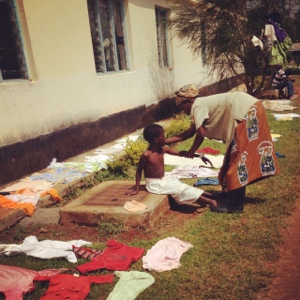
The first thing you see is the sheer number of patients that occupy the room. After that initial shock subsides, you sink into a state of acute observance. Soon, the slight breeze coming through the windows causes the gentle swaying of the nets above each bed, and you take note of the women just outside drying laundry on the dew-crested side yard. Thermoses of tea and loaves of bread fill the cabinets beside the patient beds, and some have taken to their morning routine, eating and drinking. Perhaps it's my presence or that of pain and illness that stifles much of the idle chatter--everyone seems to be merely existing, surviving. No different than in any other hospital, I imagine.
A tall, verk dark-skinned physician ("daktari" in kiswahili) approached me: "I am Dr. Mawalwi, the chief medical officer for this ward," he said with the bass of a bullfrog. The people speak softly here, almost inaudible to my western ear, but the deepness of his voice did much in the way of transmitting the message. Soon, we alighted to the theater (the OR in Africa) after our brief exchange: there was a woman with a massive spleen that needed surgical excision.
It was there we met the consultant, another tall Kenyan wth a booming voice. He had the air of a surgeon, confidence to a fault, and a belly that revealed a lifestyle different from most in this country. From gaunt to skinny, you don't see much in the way of overweight people here. In Africa, it's malaria, in America, it's Type II Diabetes. As for the consultant, he had traversed the 5 years of medical school, the year of internship, and had practiced privately many years before he began his consultantship. This was the pinnacle of the medical hierarchy in Africa, being a consultant.
The patient arrived about an hour after we had left the ward, and at this time, I had caught up with Malia, my classmate who was rotating in maternity ward. Our separate designations, OB/GYN and Maternity, beared much resemblance in responsibility, so we stuck together for the week. I enjoy her personality, and was happy to have a companion for this our first week. We enjoyed a cup of tea while we waited for the surgical theater to be prepped. Tea here is a thrice-daily occurrence. They take it solely with milk, thus bearing the name, chai na maziwa.
During our wait, Dr. Rajiv, a medical intern in OB/GYN, began operating in the side theater on a routine c-section. I had never seen such a procedure before, and was amazed at how quickly it transpired, from first cut to the appearance of the child. At some point, you realize that you're cut out for the medical profession; the large grins beneath our scrub masks surely marked this point for both Malia and myself. Little did we know that we'd be assisting on one of these procedures before the day concluded. Who knew holding a once-gravid uterus would be such a poignant experience?
***Graphic Description Ahead***
With the main theater open and Malia assisting with the c-section, I examined the belly of the patient with the large spleen. It was palpable all the way to the midline, and descended near her belly button. She looked pregnant, her belly encompassing nearly twice her pelvic width. Her liver seemed enlarged, and present well below her diaphragm. Still, the consultant kept calling it an ovarian malignancy. How could this be, I wondered? It would need to be rougly the size of a basketball in order to distend her abdomen to that extent. Plus, the splenic involvement was puzzling. Was this a blood cancer, a metastasis? As it turned out my approximation was wrong: the right ovary was larger than a basketball, and the enlarged spleen turned out to be her left ovary. It was slightly smaller, but no less impressive. Roughly 15 lbs of ovary sat on the surgical table beside the bed, with a uterus the size of small change purse sitting in juxtaposition. This girl, no older than 20, already with two children, would never bear another. Her chemotherapy would begin soon after, but these two massive organs would be the last thing to pass from her belly. I wondered if she would survive, I wondered how long she had been carrying that burden.
"Without imaging, there is no way to accurately predict what we're going to find when we go in sometimes. Surgery in Africa, you'll learn, it's all about improvisation," the consultant intoned.
Having little experience in hospitals of any kind, I felt quite awkward standing around with my hands in my pockets. I announced my presence to the day nurse in charge, and she promptly sat me in front of a mound of patient charts. "Read these," she said, and then returned to her work changing bed sheets, a chore that required a mass exodus of patients from the room until her task was complete. This happened every morning, I learned; the head nurse was the shepherd, the patients the sheep. By the time I had scanned through the charts, the menial task was complete.
The first thing you see is the sheer number of patients that occupy the room. After that initial shock subsides, you sink into a state of acute observance. Soon, the slight breeze coming through the windows causes the gentle swaying of the nets above each bed, and you take note of the women just outside drying laundry on the dew-crested side yard. Thermoses of tea and loaves of bread fill the cabinets beside the patient beds, and some have taken to their morning routine, eating and drinking. Perhaps it's my presence or that of pain and illness that stifles much of the idle chatter--everyone seems to be merely existing, surviving. No different than in any other hospital, I imagine.
A tall, verk dark-skinned physician ("daktari" in kiswahili) approached me: "I am Dr. Mawalwi, the chief medical officer for this ward," he said with the bass of a bullfrog. The people speak softly here, almost inaudible to my western ear, but the deepness of his voice did much in the way of transmitting the message. Soon, we alighted to the theater (the OR in Africa) after our brief exchange: there was a woman with a massive spleen that needed surgical excision.
It was there we met the consultant, another tall Kenyan wth a booming voice. He had the air of a surgeon, confidence to a fault, and a belly that revealed a lifestyle different from most in this country. From gaunt to skinny, you don't see much in the way of overweight people here. In Africa, it's malaria, in America, it's Type II Diabetes. As for the consultant, he had traversed the 5 years of medical school, the year of internship, and had practiced privately many years before he began his consultantship. This was the pinnacle of the medical hierarchy in Africa, being a consultant.
The patient arrived about an hour after we had left the ward, and at this time, I had caught up with Malia, my classmate who was rotating in maternity ward. Our separate designations, OB/GYN and Maternity, beared much resemblance in responsibility, so we stuck together for the week. I enjoy her personality, and was happy to have a companion for this our first week. We enjoyed a cup of tea while we waited for the surgical theater to be prepped. Tea here is a thrice-daily occurrence. They take it solely with milk, thus bearing the name, chai na maziwa.
During our wait, Dr. Rajiv, a medical intern in OB/GYN, began operating in the side theater on a routine c-section. I had never seen such a procedure before, and was amazed at how quickly it transpired, from first cut to the appearance of the child. At some point, you realize that you're cut out for the medical profession; the large grins beneath our scrub masks surely marked this point for both Malia and myself. Little did we know that we'd be assisting on one of these procedures before the day concluded. Who knew holding a once-gravid uterus would be such a poignant experience?
***Graphic Description Ahead***
With the main theater open and Malia assisting with the c-section, I examined the belly of the patient with the large spleen. It was palpable all the way to the midline, and descended near her belly button. She looked pregnant, her belly encompassing nearly twice her pelvic width. Her liver seemed enlarged, and present well below her diaphragm. Still, the consultant kept calling it an ovarian malignancy. How could this be, I wondered? It would need to be rougly the size of a basketball in order to distend her abdomen to that extent. Plus, the splenic involvement was puzzling. Was this a blood cancer, a metastasis? As it turned out my approximation was wrong: the right ovary was larger than a basketball, and the enlarged spleen turned out to be her left ovary. It was slightly smaller, but no less impressive. Roughly 15 lbs of ovary sat on the surgical table beside the bed, with a uterus the size of small change purse sitting in juxtaposition. This girl, no older than 20, already with two children, would never bear another. Her chemotherapy would begin soon after, but these two massive organs would be the last thing to pass from her belly. I wondered if she would survive, I wondered how long she had been carrying that burden.
"Without imaging, there is no way to accurately predict what we're going to find when we go in sometimes. Surgery in Africa, you'll learn, it's all about improvisation," the consultant intoned.
Sunday, June 17, 2012
How are YOU?
Trains, planes, and matatus...this is the way to Kitale. We arrived shortly after 2:30 pm (7:30 am EST) yesterday, and were greeted in typical Kenyan fashion: warm hugs, a hearty "caribou sana," and yet another delicious meal...we ate the world's best mango yesterday. Fact.
Today, we're running errands and getting settled in our new home, a beautiful farm just outside the city. Tomorrow, we begin our work in Kitale District Hospital. We're eager to begin, and it is our hope that we'll be able to give you a tiny sliver of what we're experiencing through this forum. I can guarantee you that this medium won't capture the enormous beauty of this country and the people that live here. Yet, we'll still try. Until then, we say kwaheri and hope to speak with you soon. SS
Subscribe to:
Posts (Atom)